
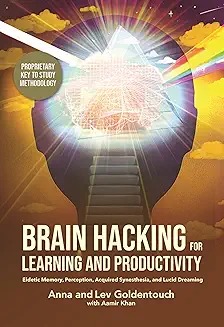
What if your brain could process information faster, more intuitively, and more creatively, simply by allowing your senses to work together more effectively? This idea lies at the heart of acquired synesthesia, a cognitive phenomenon explored in depth in the book Brain Hacking for Learning and Productivity: Eidetic Memory, Perception, Acquired Synesthesia, and Lucid Dreaming.
Synesthesia is often misunderstood as a rare or exotic condition, but modern neuroscience shows that sensory fusion is a fundamental feature of the human brain. From reading and listening to navigating space or recognizing patterns, the brain constantly blends information across senses. Learning how this process works, and how it can be trained opens new pathways for memory, perception, and intellectual performance.
This article explores the foundations of synesthesia, how it can be partially acquired, and why sensory fusion plays a crucial role in creativity, cognition, and productivity.
What Synesthesia Really Is (and What It Is Not)
Synesthesia literally means a union of sensations. In its strictest definition, it refers to unusual sensory pairings such as hearing colors or seeing sounds. However, in a broader and more practical sense, synesthesia describes the brain’s ability to integrate multiple sensory channels into a unified experience.
Many forms of mixed sensing are entirely normal. Smell and taste combine to create flavor. Vision and balance work together to maintain posture. Even reading silently involves a fusion of sight and sound through subvocalization. These examples show that synesthesia is not an anomaly but an extension of everyday perception.
What distinguishes synesthesia is cross-activation, when one sensory input consistently triggers another sensory experience. This activation occurs not in the sensory organs but within the brain’s processing centers, where networks overlap and interact.
Synesthesia and Creativity Across Disciplines
A striking number of artists, musicians, and mathematicians report synesthetic experiences. This is not a coincidence. Sensory blending opens alternative pathways for thinking, allowing abstract concepts to be perceived more vividly.
- Painters have described hearing colors or sensing rhythm in shapes
- Composers have reported seeing music as moving forms or colors
- Mathematicians often describe numbers as having texture, sound, or spatial character
These experiences transform abstract information into sensory-rich representations, enabling faster intuition and deeper pattern recognition. Importantly, synesthesia is usually directional; a person may see music without hearing colors, or visualize numbers without sensing taste.
This directionality reinforces the idea that synesthesia is not a blanket condition but a specific neural configuration.
The Brain as a Crossroads of Sensory Networks
Synesthesia does not affect the entire brain uniformly. Instead, it reflects unique patterns of interaction between specialized neural circuits. Some individuals associate letters or numbers with colors, a form of synesthesia that is particularly relevant to learning and memory.
Research shows that this type of association can be trained. With consistent exposure, often through software or structured exercises, people begin to experience these links automatically. What begins as a deliberate association gradually becomes perceptual, allowing faster detection of errors and patterns.
This demonstrates a powerful principle: perception itself can be expanded through training.
Culture, Language, and Perceptual Shaping
Perception is not biologically fixed. Culture and language shape how the senses are experienced and categorized. Historical texts describe the sea using colors that modern readers find unusual, suggesting that linguistic frameworks influence sensory interpretation.
Languages with richer color vocabularies often produce stronger color-based associations. Over time, these linguistic habits affect perceptual experience itself. Synesthesia, in this context, highlights how deeply words, symbols, and learned associations influence what we believe we are “seeing” or “hearing.”
The Benefits and Costs of Heightened Sensory Awareness
Synesthesia can amplify perception and imagination. Writers may choose words with greater precision. Musicians detect subtle tonal variations. Mathematicians intuit hidden structures.
However, increased sensory connectivity has a downside. Overactivation of multiple brain regions can lead to sensory overload. Some individuals experience headaches, emotional strain, or difficulty filtering irrelevant input.
This illustrates an important balance: expanding perception must be accompanied by regulation. Techniques such as meditation or grounding exercises help manage heightened sensitivity, reinforcing that cognitive enhancement always carries trade-offs.
Can Synesthesia Be Acquired?
For many years, scientists believed synesthesia was purely congenital. This view changed when experiments demonstrated that certain forms, especially color–letter associations, can be learned.
Participants trained with repeated pairings reported that the associations became automatic. Brain imaging confirmed overlapping sensory activation, suggesting that learned synesthesia recruits similar neural mechanisms as innate forms.
While complex experiences like tasting words remain difficult to induce, these findings confirm that partial synesthesia is trainable, especially with modern tools such as immersive software and virtual environments.
Associations vs. True Synesthesia
True synesthesia is involuntary. Learned associations begin consciously but may feel automatic over time. From a practical standpoint, the distinction is less important than the outcome.
Human cognition already relies heavily on symbolic associations. Colors evoke emotions. Shapes suggest movement. Designers and educators use these tendencies intuitively. Training stronger, more consistent associations simply builds upon this natural foundation.
If an association improves memory, comprehension, or speed, its classification becomes secondary to its usefulness.
Brain Activation and Cognitive Efficiency
Studies using functional imaging show that trained sensory blending activates multiple brain regions simultaneously, including emotional centers. This recruitment of additional neural resources enhances engagement, strengthens memory, and often makes learning more enjoyable.
Modern educational tools already apply these principles. Data visualization converts numbers into shapes and colors. Educational games integrate sound, motion, and imagery. These approaches distribute cognitive load across senses, reducing strain on any single channel.
Reading as a Form of Sensory Fusion
Reading illustrates how deeply mixed our senses already are. Most readers hear words internally as they read, a process known as subvocalization. While this supports comprehension, it also limits speed.
Speed-reading techniques often disrupt this auditory loop, forcing the brain to rely more on visual processing. Surprisingly, comprehension usually remains intact. This shows that meaning does not require auditory mediation; it can be extracted directly.
With practice, readers can bypass imagery and sound altogether, moving directly from text to understanding. This reveals the brain’s extraordinary adaptability in reorganizing sensory pathways.
Brain Preprocessing and Neuroplasticity
Each sense has specialized processing circuits, yet higher-level brain regions integrate information across modalities. When one sense is restricted, others can take over. Blindfold experiments show that visual processing areas can be repurposed for touch or sound.
This flexibility, known as neuroplasticity, underlies rehabilitation therapies and learning strategies alike. The brain reallocates resources based on demand, not fixed assignment.
Ancient brain structures handle raw sensory input, while the neocortex integrates meaning. The thalamus acts as a communication hub, routing information between senses and higher cognition.
Pretend Mixing and Practical Synesthesia
Innate synesthesia often involves structural differences in the brain, particularly in the thalamus. Learned synesthesia typically operates at the neocortical level, functioning as a simulation rather than a structural change.
Despite this, the cognitive benefits are real. Color-coded notes, memory palaces, and multisensory study tools train the brain to process information in synesthetic-like ways. Educational technologies increasingly use augmented reality, sound, and tactile feedback to accelerate comprehension.
Fused Senses and Everyday Perception
Many sensory experiences are already fused. Spiciness, for example, is not a taste but a temperature and pain response. Motion sickness arises when visual and vestibular inputs conflict.
The cerebellum plays a critical role in merging sensory information for balance and orientation. In the neocortex, sensory conflicts, such as those demonstrated by the Stroop effect, reveal how perception and cognition compete for dominance.
These interactions are essential for survival, navigation, and attention.
Prediction, Cross-Validation, and Intelligence
The brain continuously predicts and cross-validates sensory input. This allows us to track objects, anticipate movement, and navigate complex environments. Even when sensory information is incomplete, the brain fills in gaps using memory and expectation.
This predictive fusion mirrors modern intelligent systems, such as autonomous vehicles, which integrate multiple sensors to build reliable models of reality.
Synesthesia builds upon this existing machinery, extending the brain’s natural tendency to combine information across channels.
Logical Chains vs. Template Matching
Different sensory systems support different processing styles. Vision excels at pattern recognition. Sound supports temporal sequencing. Logical reasoning relies on step-by-step chains, while intuition depends on template matching.
Expert performance emerges when these systems cooperate. Chess masters, athletes, and performers integrate logic and intuition seamlessly. In flow states, the brain synchronizes relevant systems while suppressing distractions, enabling extraordinary efficiency.
However, prolonged imbalance can lead to exhaustion, reinforcing the need for controlled integration.
Multisensory Learning and Cognitive Expansion
Distributing information across senses reduces cognitive load. Ancient learning traditions used rhythm, chanting, and imagery to encode knowledge. Modern tools replicate these strategies using color, sound, and interaction.
By making information available to multiple sensory systems, learning becomes faster, more resilient, and easier to recall.
Conclusion: Training Perception for Higher Learning
Synesthesia is not an isolated anomaly but a window into how the brain naturally processes information. Whether innate or trained, sensory fusion reveals the flexibility of human cognition and its capacity for growth.
By understanding and applying these principles, learners can enhance memory, creativity, and comprehension without adding complexity, only by reorganizing perception.
If you want to explore these ideas further, they are explained in depth in Brain Hacking for Learning and Productivity: Eidetic Memory, Perception, Acquired Synesthesia, and Lucid Dreaming. To deepen practical application, the course ProlificFocus: Wellbeing, Hobbies and Sleep-Hacking Masterclass expands these concepts into actionable training.
📩 Contact us directly at info@keytostudy.com and start unlocking your brain’s full potential today!