
Some information is naturally memorable. Stories, images, and emotions often stay with us effortlessly. But what about names, numbers, dates, formulas, or dense technical text? These elements often feel abstract, repetitive, and resistant to traditional memorization methods.
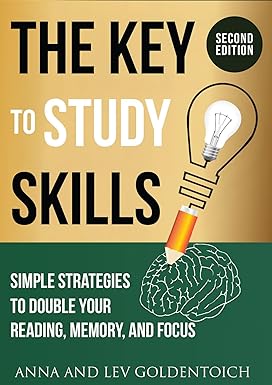
In The Key to Study Skills (2nd Edition): Simple Strategies to Double Your Reading, Memory, and Focus, powerful techniques are introduced to help learners encode even the most difficult material without relying on endless repetition. These methods focus on giving abstract information meaning, structure, and visual form, allowing the brain to retain it efficiently.
This article explores three essential tools: the Major System, methods for memorizing detailed text, and mind mapping. Together, they form a flexible system for mastering complex material efficiently and reliably.
Why Abstract Information Is Hard to Remember
The brain remembers meaning, not symbols. Numbers, unfamiliar names, codes, and technical terms often lack inherent meaning, making them difficult to store and retrieve.
Instead of repeating these elements until they stick, the KeyToStudy approach asks a different question:
How can we transform abstract information into something the brain already knows how to remember?
The answer lies in dictionaries, systems that translate difficult material into familiar, memorable forms.
The Major System: Turning Numbers Into Meaning
The Major System is one of the most effective mnemonic tools for encoding numbers, names, and abstract sequences.
Rather than memorizing digits directly, each number is mapped to a consonant sound. These consonants are then turned into words, images, and stories that are easy to remember.
A Brief History of the Major System
The Major System has ancient roots:
- In Hebrew traditions, letters double as numbers
- In Hindu culture, the Katapayadi system encoded astronomy and mathematics in poetry
- In 16th-century Europe, mnemonic systems were refined for structured learning
Modern variations, such as Dominic O’Brien’s techniques, combine the Major System with memory palaces for competitive-level memory performance.
Dictionaries: The Core of Abstract Memorization
At the heart of the Major System is the idea of one-to-one correspondence.
You translate:
- Numbers → letters
- Letters → words
- Words → images
This concept can be extended beyond numbers. Whenever something is:
- Too abstract
- Too repetitive
- Too similar to other items
You can create a custom dictionary to encode it.
As long as each difficult element maps consistently to something familiar, recall becomes reliable.
When Should You Use a Dictionary System?
Dictionary-based memorization works best when information is:
- Highly repetitive
- Structurally similar
- Difficult to visualize directly
Examples include:
- Numbers and dates
- Passwords and codes
- Scientific notation
- Color categories
- Names and unfamiliar terms
Once the dictionary is learned, encoding becomes fast and almost automatic.
Is Spaced Repetition Still Necessary?
Spaced repetition is often studied using information that is intentionally hard to remember. Dictionary systems shift effort upfront.
There is a clear tradeoff:
- Initial effort to learn the dictionary
- Long-term efficiency when applying it repeatedly
Once the system is internalized, recall requires far less repetition.
Teaching the Major System Simply
Some dictionary variations are extremely simple:
- First-letter systems
- Rhymes
- Verses
These approaches are easy to explain, even to children. The creative effort lies with the person designing the mnemonic. For the learner, recall feels effortless.
Why Common Things Are Often Forgotten
Rare or unusual information forces the brain to create specific markers. Common names and generic terms, however, are easily confused.
Dictionaries solve this problem by assigning distinct identities to otherwise similar items. Even names and definitions usually have etymological roots that can be used as markers.
Synesthesia and Automatic Encoding
Synesthesia replaces one sensory dictionary with another:
- Letters → colors
- Sounds → shapes
- Feelings → textures
This automatic translation closely resembles the Major System. Once associations are learned, encoding happens instantly, similar to how programmers benefit from syntax highlighting.
Memorizing Numbers: Practical Systems Compared
Mnemonics
Mnemonics use word length or structure to encode numbers. Many classic examples exist, such as poems encoding digits of pi.
These are effective but often specific to one number.
The Major System
Using consonant mappings, numbers become words that can be linked visually.
Example consonant table:
- 0 → S or Z
- 1 → D or T
- 2 → N
- 3 → M
- 4 → R
- 5 → L
- 6 → J / SH / ZH
- 7 → K / hard G
- 8 → F / V
- 9 → B / P
These mappings can be adjusted for language differences to prevent confusion.
Dominic System
The Dominic System maps numbers directly to letters and people.
Each two-digit number becomes:
- A person
- Performing an action
- Using an object
This naturally leads to PAO systems.
PAO: The Most Efficient Number System
PAO (Person–Action–Object) is especially powerful because:
- It compresses information
- It integrates easily with memory palaces
- It works well with real-world numeric formats
Since many numbers appear in six-digit structures (dates, engineering values, financial figures), PAO is particularly effective.
Care must be taken with:
- Decimal points
- Signs
- Order of magnitude
Using Logic as a Safety Net
Memorization should not exist in isolation. Logical understanding provides error checking.
For example, understanding what pi represents geometrically helps ensure:
- Correct placement of decimal points
- Proper scale
- Reasonable approximation
Logic strengthens and validates mnemonic systems.
How to Memorize Detailed Text
Complex paragraphs can be encoded in two ways:
- Technically, using memory palaces and PAO
- Creatively, using humor, tone, and vivid imagery
The creative approach is often faster and more flexible.
Breaking Dense Information Into Markers
For detailed text:
- Break information into smaller units
- Maintain a consistent tone
- Use humor where appropriate
- Rely on prior knowledge
Markers should connect to what you already know, movies, language roots, familiar images, or existing concepts.
Memorizing Technical Lists and Descriptions
Highly technical material (such as anatomy or scientific descriptions) requires:
- Concrete imagery
- Linguistic associations
- Emotional exaggeration
The goal is not realism, but memorability.
Once each item has a distinct marker, recall becomes reliable even without labels.
Handling Mental Blocks
Mental blocks are normal and temporary. When visualization fails, several strategies help restore flow:
- Relaxation: calming imagery and deep breathing
- Movement: walking or light physical activity
- Dual coding: switching to an alternative method
- Sleep: allowing subconscious processing
- Search: triggering associations indirectly
Always maintain a backup method.
Mind Mapping: Encoding Structured Knowledge
Books and articles are naturally hierarchical. Mind maps mirror this structure perfectly.
A mind map represents:
- An article
- A chapter
- Or an entire book
Multiple mind maps can connect into larger systems.
The Key Components of an Effective Mind Map
Anchor
The root of the map. It summarizes the essence of the content and must be unforgettable.
Retrieval Markers
High-level triggers that allow recall from multiple perspectives. These require significant investment.
Main Branches
Core ideas, usually three to six, corresponding to sections.
Smaller Branches
Supporting ideas and arguments, usually two per paragraph.
Leaves
Details such as names, numbers, and facts.
Strings (Hyperlinks)
Connections between different maps and ideas, enabling creativity and analysis.
When Mind Mapping Works Best
Mind maps are ideal for:
- Articles
- Textbooks
- Computer programs
- Presentations
They are less suitable for:
- Memory sports
- Real-time conversations
Mind Mapping on a Clock Face
Using an analog clock:
- The anchor is placed at 12
- Main branches occupy odd hours
- Even hours are reserved for additions
This structure preserves order, relationships, and flexibility.
Combining Mind Maps With Other Systems
Mind maps integrate well with:
- Memory palaces
- PAO
- Major System labels
They can be moved, reshaped, flattened, or expanded as understanding grows.
Conclusion
Abstract information does not have to remain difficult. By using dictionary systems like the Major System, creative encoding for detailed text, and structured mind mapping, even the most complex material becomes manageable.
Unlock Your Full Learning Potential Today
All of these proven techniques are explained in depth in The Key to Study Skills (2nd Edition): Simple Strategies to Double Your Reading, Memory, and Focus. This book is your complete roadmap to mastering reading, memory, and focus, turning overwhelming information into structured, easy-to-remember knowledge.
For hands-on guidance and step-by-step training, KeyToStudy: Memory Masterclass takes you through every system, helping you apply these strategies effectively and confidently in real learning situations. Memory isn’t just repetition; it’s about structure, meaning, and smart encoding, and this course ensures you implement it correctly.
📩 Email us at info@keytostudy.com to receive exclusive discounts on the KeyToStudy: Memory Masterclass and start mastering names, numbers, and complex text with ease. Take action today and transform the way you learn!