
Modern productivity culture often equates success with flawless execution, rigid systems, and constant optimization. Yet this pursuit of perfection frequently creates friction, burnout, and diminishing returns. True productivity is not only about eliminating waste, but it is also about understanding where precision matters and where flexibility creates value.
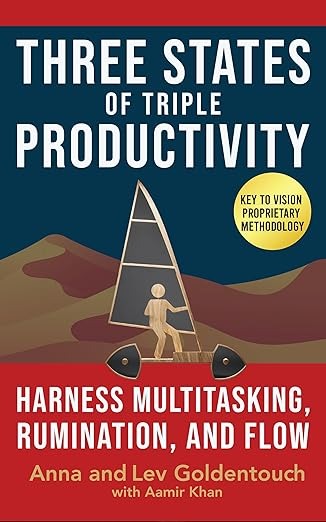
This deeper perspective is explored throughout the book THREE STATES OF TRIPLE PRODUCTIVITY: Harness Multitasking, Rumination and Flow, which reframes productivity as a balance between structure, adaptability, and sustained focus. Rather than chasing perfection, the book emphasizes clarity, intentional practice, and long-term mastery.
This article explores three interconnected ideas, Wabi-Sabi, Overlearning, and Life-Long Focus, and shows how they collectively shape a more sustainable and meaningful approach to productivity.
Wabi-Sabi: The Productivity of Imperfection
Understanding Wabi-Sabi
Wabi-Sabi is a Japanese philosophy that finds beauty and value in impermanence, simplicity, and imperfection. Emerging in the 14th century alongside Zen Buddhism and the Japanese tea ceremony, it challenged rigid ideals of symmetry and flawlessness. Instead, it honored the natural aging of materials, the uniqueness of handmade objects, and the quiet elegance of simplicity.
In productivity terms, Wabi-Sabi offers an important correction to perfectionism. It reminds us that systems, workflows, and skills must evolve. What works today may not work tomorrow, and that is not failure, but reality.
Wabi and Sabi: Two Pillars of Imperfection
Wabi: Simplicity and Purpose
Wabi represents understated elegance and functional simplicity. It values objects and processes that are stripped of unnecessary complexity and focused on their essential purpose. In work, this translates to lean workflows, clear priorities, and tools that serve function rather than aesthetics alone.
Sabi: Aging, Use, and Experience
Sabi reflects the beauty that emerges through time and use. Wear, repetition, and experience create depth rather than degradation. Applied to productivity, Sabi encourages respect for accumulated skill, institutional knowledge, and systems refined through real-world use rather than theoretical perfection.
Handcrafted Precision vs. Standardization
Not all mastery scales. Certain skills require deep focus, control, and personalization. While standardized systems enable efficiency and mass coordination, they often sacrifice precision and adaptability.
This distinction highlights an important productivity lesson: standardization is a tool, not a rule. High-volume processes benefit from consistency, but high-stakes or high-skill tasks often demand customization, patience, and refinement. Knowing when to apply each approach prevents waste without undermining quality.
Finding Value in Anomalies
Deviation from norms is not always a defect. In many cases, anomalies introduce resilience, adaptability, and unexpected effectiveness. Natural processes demonstrate this clearly: erosion, wear, and irregularity often enhance function rather than diminish it.
In cognitive and professional work, flexibility allows innovation to emerge. Rigid systems may optimize short-term efficiency, but adaptive systems generate long-term value. Productivity improves when variation is understood rather than eliminated indiscriminately.
Overlearning: Mastery or Waste?
What Is Overlearning?
Overlearning refers to practicing a skill beyond initial mastery until execution becomes automatic and effortless. In certain fields, such as medicine, aviation, law, or engineering, this depth of mastery reduces error and increases reliability.
However, overlearning carries a cost. Time, energy, and attention invested in perfecting one skill cannot be invested elsewhere. When overused, overlearning becomes a form of waste rather than refinement.
The Zero-Waste Trap
The pursuit of flawless performance can create a paradox. While aiming for zero defects, individuals may:
- Delay action by excessive refinement
- Miss opportunities for diversification
- Experience cognitive fatigue or burnout
- Accumulate knowledge without application
In environments saturated with information, continuous learning without execution becomes unproductive. Knowledge only creates value when applied.
Overlearning vs. Moving Forward
The decision to deepen mastery or move on depends on several factors:
- Goals: Depth versus adaptability
- Nature of work: Precision-based or exploratory
- Cognitive load: Sustainability over time
True productivity emerges from balance, deep expertise supported by complementary skills.
Overlearning in Learning Systems
When applied intentionally, overlearning strengthens retention and performance. Effective strategies include:
- Spaced repetition to consolidate memory
- Active learning through application
- Focused scope to reduce cognitive overload
- Follow-up reinforcement after completion
- Targeted refreshers rather than repetition for its own sake
These methods prevent waste while preserving long-term capability.
Life-Long Focus: The Foundation of Mastery
The Concept of Master and Takumi
Japanese culture distinguishes between technical mastery and lifelong devotion to craft. While mastery may require thousands of hours, the concept of Takumi reflects decades of focused refinement, respect for the work itself, and continuous improvement.
This approach reframes productivity as a long-term commitment rather than a sequence of short-term optimizations.
Life-Long Focus Is Universal
Life-long focus is not culturally limited. Across disciplines and traditions, sustained attention to a single craft consistently produces exceptional outcomes. What matters is not speed, but continuity, reducing distraction, minimizing cognitive waste, and refining skill through deliberate practice.
This aligns directly with the principle that Muda equals waste. Distraction, superficial learning, and constant context-switching dilute progress.
The Science of Focus and Flow
Sustained focus enables a neurological state known as flow, characterized by deep concentration, reduced mental noise, and heightened performance. Repeated focused practice strengthens neural pathways, improving:
- Memory retention
- Processing speed
- Precision and consistency
Focused work eliminates cognitive waste by aligning effort with intention.
Overcoming Challenges to Life-Long Focus
Life-long focus does not eliminate obstacles. Instead, it requires systems to navigate them:
- Clear goal-setting to maintain direction
- Intentional boundaries to reduce distraction
- Supportive environments that reinforce consistency
- Mindfulness practices to regain attention
- Recognition of progress to sustain motivation
Each tool reinforces focus while preventing burnout.
The Rewards of Sustained Focus
Life-long focus delivers outcomes that short-term productivity cannot:
- Purpose: Clear direction and meaning
- Mastery: Depth that compounds over time
- Flow: Consistent access to peak performance
- Serenity: Alignment between effort and values
Productivity becomes not just output, but fulfillment.
Conclusion: Productivity That Endures
Wabi-Sabi teaches acceptance of imperfection. Overlearning warns against wasted refinement. Life-long focus reveals the power of sustained attention. Together, they form a productivity philosophy grounded in realism, discipline, and meaning.
These ideas are explored in greater depth in the book THREE STATES OF TRIPLE PRODUCTIVITY: Harness Multitasking, Rumination and Flow, which offers a structured framework for eliminating waste, cultivating focus, and achieving long-term productivity without burnout.
For practical application, the course ProlificFocus: Productivity Masterclass (Time Management, Multitasking and Flow) translates these principles into actionable systems.
📩 Contact via email for exclusive course discounts:
info@keytostudy.com
True productivity is not about perfection.
It is about focus, intention, and mastery over time.