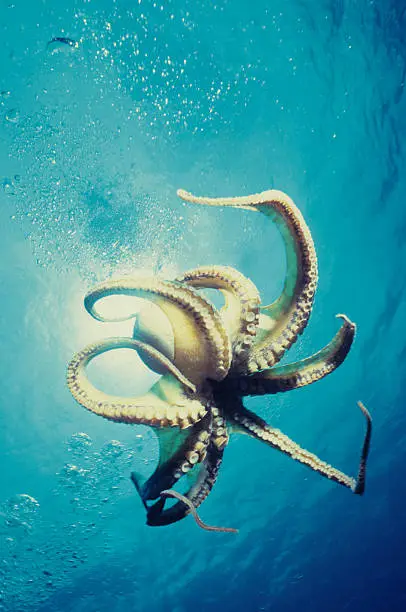
An octopus multitasking sounds funny to ordinary people, but when we look at life underwater, the octopus appears to be a pro multitasker. The octopus, having eight flexible limbs, a highly developed brain, and the ability to individually control its arms, represents the multitasking theme in the world of animals. This mysterious underwater creature has been a topic of fascination for scientists and storytellers for a long time. Its odd body structure, intricate nervous system, and quite high intelligence level make it a living model of coordination, puzzle-solving, and adaptability. The octopus is the only example of a virtual assistant in the whole bio-world; an organism inherently possesses a network of collective assemblies of likened functionality to virtual computing.
Anatomy of an Octopus: A Design Built for Multitasking
Octopus bodies appear to be exceptionally different between species. The octopus even looks a bit strange at first sight since it has a big head and eight quite long arms. Nevertheless, such anatomy serves as their body design and enables them to perform various tasks simultaneously. The arms are lined with sucker-cup structures, which enable the gripping, tasting, and feeling of different parts with independent motion. For the human body, the system of control, for example, the brain controls the different limbs, is another story, whereas each arm of the octopus houses small “brains” or ganglia that work independently. These ganglia allow each arm to collect data and respond to stimuli on its own without involving the central brain, thereby enabling the octopus to act in multiple directions at once.
Octopuses have a nervous system that is both decentralized and functioning, which is necessary for multitasking. To demonstrate the idea: one arm of the octopus may be exploring a crack to look for food, while the other might be stripping a shell from a male, and the third secure the animal to the rocks. Such simultaneous actions from the octopus come off smoothly and without the loss of the quality of the performance, which proves that the octopus is indeed made out for running multiple things at once structurally.
Octopus Multitasking: The Brain Behind the Scene
Octopuses are equipped with more than half a billion nerve cells, which exceeds the numbers of such cells in most invertebrates and even some mammals. Surprisingly, two-thirds of them are found not in the central brain but in the arms. This way of neuron distribution facilitates decision-making on their own for every arm and maintains proper communication between the body’s parts. This two-processes model of information exchange is one of the factors why octopuses are the best in multitasking.
Octopuses in laboratories have been discovered solving mazes in jars and using tools, and if the experiment was short, they could do all of these tasks successively. In their natural environment, they are at the same time evaluating hazards, looking for food, changing the color of their skin to match the background, and controlling their position. These mental capacities are the direct product of an evolutionary design spur that gives stress to distributed intelligence.
Their skills in learning are also very high. Octopuses can learn from observing others, recall puzzle-solving methods, and change their behavior according to previous experience. The mental agility that they possess is only one more of the many layers in Octopus’s multitasking that form a complex whole, which we are starting to understand.
Independent Arm Coordination: A Lesson in Autonomy
Octopuses are perhaps the most extreme example of multitasking, namely their autonomous arms. In the case of octopuses, each one of their arms moves and does its function perfectly but still in coordination with the rest of the animal’s body. Just imagine if you were an octopus and doing your work with just one of your arms; would that be a possibility? It could happen because the others would engage in other things: one of the other arms would wash the dishes, while the next one would make the bed, the third one would answer the phone, and the fourth arm would feed the dog. This gives an idea of what the octopus can do.
It has been reported that touch and pressure on octopuses’ arms can be processed without the ion brain. It turns out that they can solve problems such as opening containers or moving objects without the octopus seeing the whole process. By dividing the duties among the arms, not only is mental energy preserved but also multitasking in real-time is done, which is just impossible in the whole animal kingdom.
The biotechnological field of Animal is modern and allows more flexible input. For instance, multitasking can be approached not with a single central power but through a decentralized mode where various components function semi-independently; this leads to a high level of productivity and coordination as noted.
Camouflage and Movement: Simultaneous Mastery
One of the more unique things an octopus can do is to change colors and still be able to do many other things at the same time. The octopus skin has chromatophores which are pigment cells that either extend or contract to change color. These cells are controlled by the nervous system and can be used to form irregular patterns, making them look similar to the surroundings.
The octopus is a fast swimmer due to its body reshaping and jet propulsion, but it can also crawl slowly using its arms. It is an explorer that, besides hunting, maneuvers bad terrain and even reproduces—all done so that they are unnoticed as rocks, coral, or sand.
This is somewhat as fantastic as a person initiating a ballet move while cloaking and answering an interviewer’s questions from a moving video background. The octopus doesn’t do it for fu, but as a response to a dangerous situation; thus, it discloses the depth and extent of its multitasking armamentarium.
Hunting and Eating: Managing Prey with Precision
Octopuses are smart hunters who hide and apply the knowledge and precision needed to nail down and eat their prey. The usual hunting method implies that the octopus, camouflaged, looks inside the crevices with its arms. When the prey is found, that’s when another arm will quickly take it so satisfyingly while the other lower body part will subdue or eat it.
While being fed, the octopuses still watch the surroundings to detect the predators and also use their camouflage to disappear. They might even be dealing with a few trapped animals at once. These kinds of activities require the brain to be functioning in high gear—from sensory input, decision-making, and mechanical control to the execution part, all of which are done at the same time.
This multifunctional way of doing the hunting task became the reason behind the scientists’ aid in the comparison of the octopus’s brain and behavior to artificial intelligence systems. The way the inputs are processed, the change is created, and the many actions taken simultaneously are reflections of the future AI and robotics designs.
Social Interactions and Problem Solving
Even though the octopus generally has a solitary nature, some species have been inclined to display unexpected social behavior in human-controlled environments. These activities involve signaling, mimicry, and playfulness that are the kind of activities that might suggest that the animals have higher-level cognitive functions according to those studies.
The octopuses were noticed to be quite curious as they interacted with objects, carried out complex problem-solving activities, and even took part in what was mistaken for pranks. One of the most well-known examples was an octopus that kept turning off the lights in the aquarium, despite all the efforts made by the staff to stop it. It needs concentration, scheming, and power—all at once.
The octopus’ multitasking ability is clearly manifested in the ways how the animal deals with the environmental changes, measures the possibilities, and formulates the plans—all of which have to be done while the animal keeps alertness to the possible threats or advantages.
Symbolism of Octopus in Human Culture and Productivity
Nowadays, the octopus has become a symbol that reflects the way humans take on several tasks with multitasking, by dint of the many applications and firms that operate based on this innovative method. Distributed Control, regularly applied by the octopus, finds a parallel feature in business as well. This concept accords with the world of nature, where leaders are there to provide guidance and not overly control the process. Trust, autonomy, and local decision-making are the most effective ways for a team to perform better than expected.
Both the simple and subtle actions of the octopus show how businesses can also enjoy the virtues of multitasking. The principle of decentralized control- where teams or departments operate semi-independently yet remain connected to a central vision does not help in doing business. This case tells us that micromanagement is not a rule of thumb as more positive results can be expected by having trust in and autonomy of employees along with their local decision-making.
Being the octopus is also interchangeable with adaptability. The octopus’s dynamic capacity to switch its color, shape, and behavior in milliseconds is a real-life example of the need to be flexible, agile, and efficient in a world that demands constant learning and quick results.
Challenges and Limits to Octopus Multitasking
Although multitasking is an octopus’s major competence, it is not an absolute one. Their life span is very short—many live just a year or two—which puts into question the degree to which their intelligence grows over time. Furthermore, even though they can handle multiple stimuli, they can be overwhelmed by very stressful situations, just like any other creature.
One more limitation is the fact that octopuses are very solitary animals. In contrast to social insects or mammals, octopuses commonly live alone which means their multitasking is a one-person show rather than a group effort. This difference is crucial when compared to human multitasking in team settings.
Even so, they are still unique in many areas, and their weakness reveals the limits of natural evolution rather than flaws in multitasking itself.
Human Lessons from Octopus Multitasking
Plebs are mistaken when they think multitasking implies in it doing many things at once, all of them badly. The octopus contrarily paints a different picture. It is not about doing too much but about giving priority to certain tasks, autonomy, and understanding the environment. Instead of demanding the entire task from the central brain (like our brain), the octopus parcellates the tasks into semi-independent systems, which enables real-time performance with no overexertion.
According to this biological model, the efficiency of human workflows may be improved by transforming them into decentralized networks, while better task delegation and semi-independent tools would also be helpful. No matter whether it is project management or personal time allocation, proving the octopus’s principles correct can lead to more efficient outcomes.
Besides the anatomical perspective, octopuses can be considered role models, showing us the need for self-organization and stability when we perform several tasks in parallel. Its calm, composed method, in contrast to the frantic behavior of a multitasker, reminds us that the key to multitasking is not the number of tasks but the orchestration (Jaswal & Chib, 2011).
Final Thoughts: The Octopus as a Multitasking Marvel
In our day and age, multitasking is one of the big evils, but it can also be seen as a necessary evil. It’s an amazing way for octopuses to survive and do it better. One of the ways they accomplish this is by practicing coordinated, multi-tasking mechanisms by sending the whole body to a secluded location for protection.
Ocean, our multitasking lessons go further than purely marine biology. They encompass business, design, AI, and personal well-being. Instead of trying to simulate the human chaos of multitasking, we should see the octopus as a role model for balance, autonomy, and smooth adaptation.
Loading the sea with some technological products to speed up some of the work that we currently do, we continue to work hard to better ourselves along the lines of time, mind, and machine management. The quirky octopus is the one who, by way of example, shows us that the right ones are where they should be. In a way, it affects the naturalness of the universe when it teaches us to face complex problems with the same ease octopi can do. That is right about octopus multitasking in the sense that it is not merely a biological phenomenon, but the modern lifestyle still makes use of it as the basic scheme to model.